-
The Life Sciences Technology Cluster (Bioga) and the Galician Supercomputing Center are already working to “identify needs and create tools” that will boost the innovative potential of the biotech sector
-
The president of Bioga considers it a “responsibility and an opportunity” that the Galician Research and Innovation Plan 2025-2027 identifies biotechnology, AI and quantum technologies as strategic areas.
-
The Galician Supercomputing Center currently operates with more than 400 bioinformatics applications, to which it dedicates 30% of its storage.
-
“Cesga is a lever for competitiveness for Galician biotechnology; our collaboration is strategic,” says José Manuel López Vilariño, president of Bioga.
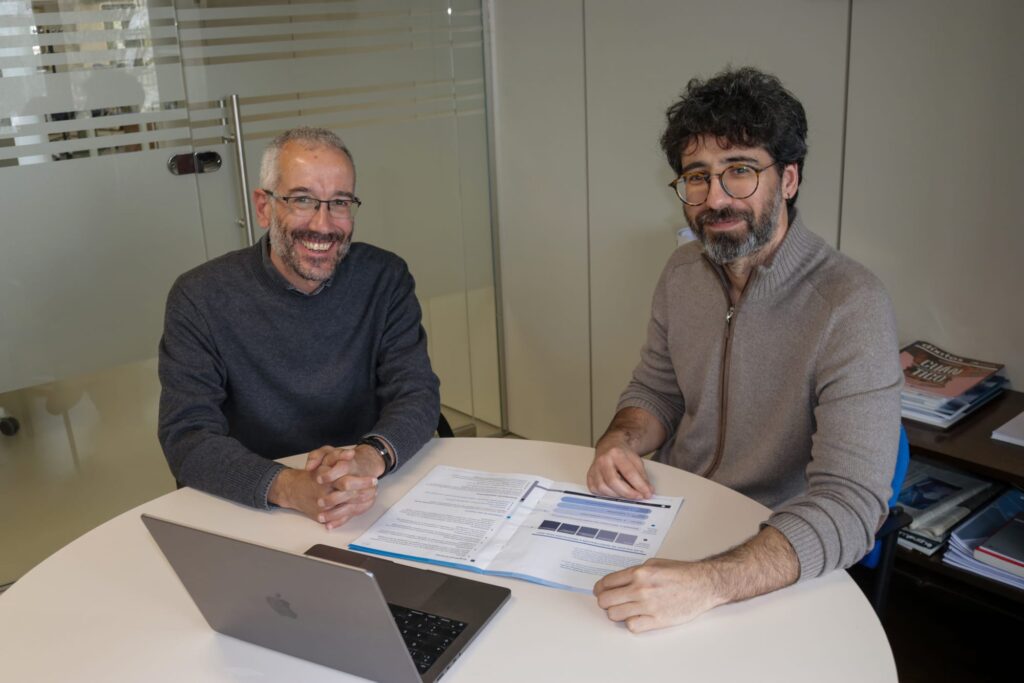
Santiago, April 15, 2025. The Galician biotechnology ecosystem, represented by Bioga, and the Galician Supercomputing Center (Cesga) are strengthening their commitment to ensuring that high-performance computing develops the full potential of the biotechnology sector in Galicia and increases its competitive advantages. The two entities demonstrate their commitment to a “firm and decisive collaboration,” which began more than 15 years ago. This was reaffirmed by the president of Bioga, José Manuel López Vilariño, and the director of Cesga, Lois Orosa. “We are a key and strategic ally for the biotechnology sector and we work daily to identify needs that help improve its competitiveness,” emphasizes the head of Cesga. “Cesga is a driver of competitiveness for the biotechnology sector; our collaboration will be key to advancing in a competitive environment with very high added value,” adds the president of Bioga. Both entities work to achieve, among other objectives, a reduction in costs in the design of new compounds and a reduction in the time required to find new drugs.
The collaboration between Bioga, an organization with over 100 members, and Cesga is presented as fundamental. Both parties are aware of this. Furthermore, it is outlined in the roadmap of the Galician Research and Innovation Plan 2025-2027, presented just a few days ago by the President of the Xunta, Alfonso Rueda. In his opinion, “R&D opens doors, creates opportunities, generates stability, wealth, employment, and accelerates the improvement of competitiveness.” The regional government’s project identified “biotechnology, artificial intelligence, and quantum technologies” as strategic areas, coinciding with the work areas of Bioga and Cesga, which are committed to consolidating their ties to strengthen talent, specialization, and knowledge transfer to the productive sector.
Responsibility and opportunity
The president of Bioga believes it “is a responsibility” that the Galician Innovation and Research Plan 2025-2027 “has focused on biotechnology, quantum technologies, and AI”. He considers it a unique opportunity. “This strategy is a success because it puts the spotlight on life sciences and supercomputing, and because it will help to renew and modernize the Galician economy,” adds José Manuel López Vilariño.
Lois Orosa, for her part, points out that Cesga is working to meet the plan’s objectives. “We identify needs and are moving forward to implement new tools and services” that will be available to the biotechnology ecosystem. She cites the example of a Data Space Demonstrator specializing in One Health, which will facilitate the use of information for research in the biomedical field for companies and public entities. Cesga is currently seeking qualified professionals to develop this initiative. She also notes that Bioga “has companies and projects working in these areas” that “will be able to work with this new tool.”
400 bioinformatics applications
Luis Orosa points out that one of the main focuses of the Galician Supercomputing Center (CESGA) is bioinformatics. “We have more than 400 applications installed in this area, and another 100 related to chemistry and materials”, says the CEO of CESGA, who estimates that “the life sciences sector consumes around 30% of CESGA’s computing capacity.” “Our commitment to the biotech ecosystem is unwavering,” adds the director of the Galician Supercomputing Center.
High-performance computing (HPC) is already an indispensable tool for the Galician biotechnology sector. “It is a fundamental driver for our companies to continue innovating and developing new projects,” says the president of Bioga. But in what practical examples can supercomputing or quantum technology help the biotech ecosystem? Cesga mentions, for example, High-Throughput Virtual Screening (HTVS), Advanced Molecular Modeling and Simulation, Structure-Based Drug Design, Large-Scale Data Analysis for Genomics and Personalized Medicine, and Artificial Intelligence and Machine Learning.
Accelerate processes
Lois Orosa, in summary, highlights that high-performance computing can help Galicia’s biotechnology ecosystem “drastically accelerate the drug discovery process; reduce research costs; explore new areas; obtain precise information on molecular interactions; predict new properties of compounds in early stages; and facilitate the rational design of compounds and drugs with greater efficacy and safety.” These are just a few examples.
The president of Bioga, for his part, reiterates that there is “enormous potential.” In his opinion, “collaboration between the biotechnology sector and supercomputing is strategic in a society that values knowledge; and it will continue to grow in the coming years.” José Manuel López Vilariño points out that “new tools and large databases are now available and accessible to researchers and sectors that, just a few years ago, had no access.” “We identify great potential in areas of work that require understanding the behavior of individual molecules in biological environments; therefore, the future of food and functional cosmetics also lies there,” notes the president of the Life Sciences Business Technology Cluster, a sector that generates more than €1.6 billion annually and creates almost 5,000 direct jobs.