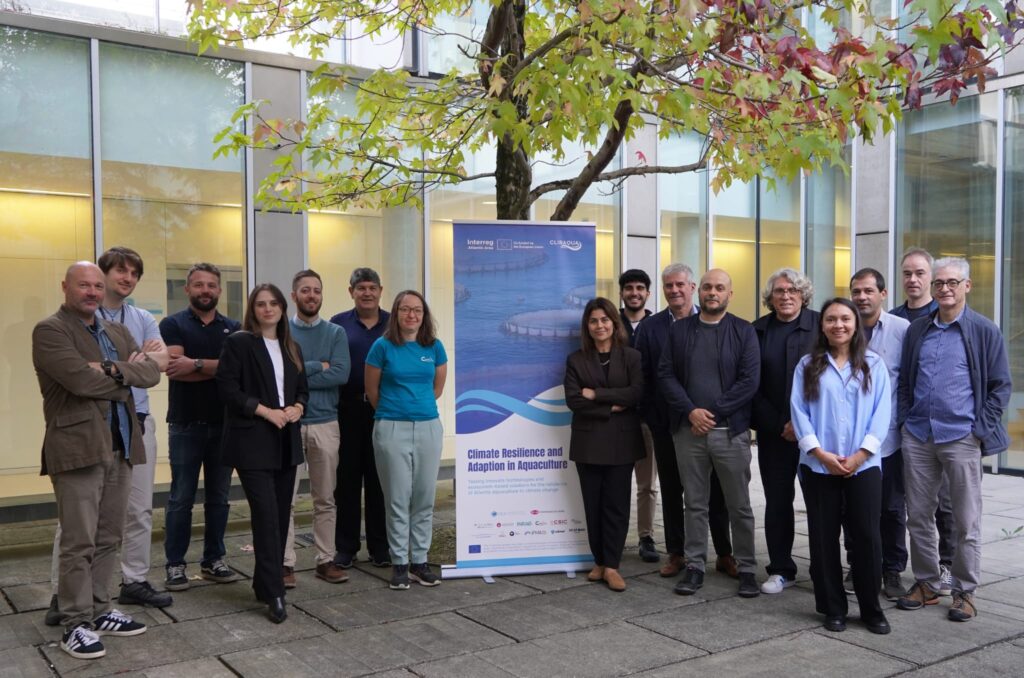
Bioga participates in four transfer projects and Galicia leads Cliraqua, on climate change
Santiago de Compostela, 11 Januray 2026. Reducing the vulnerability of aquaculture species and environments to phenomena such as rising temperatures, salinity, and declining water quality, while simultaneously developing practical tools that enable producers, government agencies, and local communities to anticipate and adapt to these challenges, are the objectives of Cliraqua, a European research project led by the University of A Coruña through the Interdisciplinary Center for Chemistry and Biology (CICA), with the Bioga cluster as one of its main partners.
The consortium, which includes research centers and companies from Spain, Portugal, Ireland and France, will create a repository of climate and ecological data, interactive vulnerability maps and management protocols to optimize aquaculture in environments modified by climate change.
In addition, an early warning system will be implemented to address diseases associated with changes in temperature and salinity, and a Transnational Aquaculture Resilience Network will be created to lay the foundations and facilitate the adoption of good practices in this sector.
Aquaculture is a strategic sector in Galicia, a leader in production, with more than 2,600 companies employing more than 5,000 people and a business volume that in 2023 exceeded 200 million euros, according to data from the Consellería do Mar, making it essential to provide tools so that aquaculture can face climate change with resilience.
All the tools created within the Cliraqua project will be available to producers, policymakers, researchers, and local communities.
“We promote collaborative innovation projects, where applied research finds avenues for industrial development, both within Galicia and internationally,” explains Loli Pereiro Mato, manager of Bioga. Along with Cliraqua, Bioga is participating this year in three other knowledge transfer projects.
“We are committed to collaboration between universities and businesses.”
Knowledge transfer has been one of Bioga’s cornerstones since the cluster’s inception. “With the aim of building a valuable ecosystem that allows us to attract investment and good ideas, we are committed to collaboration between universities and businesses, creating shared spaces,” explains José Manuel López Vilariño, president of Bioga.
“We work to ensure that ideas born in laboratories find their place in the market,” says Elena González Martín, project manager at the Galician life sciences cluster. One of the keys to Bioga’s work is precisely its ability to build networks. Thanks to its presence in the national cluster network and its international reach—with collaborations in Latin America, Ireland, and the United States—Bioga has become a meeting point for universities, technology centers, and companies.
“We promote events such as speed dating, rapid meetings to share potential projects, and talent days to present our companies and job opportunities to young researchers. We also collaborate with the master’s programs at the three Galician universities, as well as with their technology transfer offices, to ensure that good ideas don’t go to waste and to foster the industrialization of knowledge,” says López Vilariño, who emphasizes that “the biotechnology sector is highly knowledge-intensive. Talent, research, and knowledge will be critical in the coming decades in Europe to improve the productivity of its economic model.”
Article taken from La Voz de Galicia: Acuicultura resiliente