He explains that the initiative identifies “biotechnology, artificial intelligence, quantum physics, and clean technologies” as high-impact areas, in which Galicia particularly excels.
-
He indicates that the objective is “to consolidate Galicia as a leading center for research and innovation at the European and global levels.”
-
He notes that Galicia is the region where R&D investment grew the most, by 28%, and the number of employees in the field increased by 12% to 13,856.
-
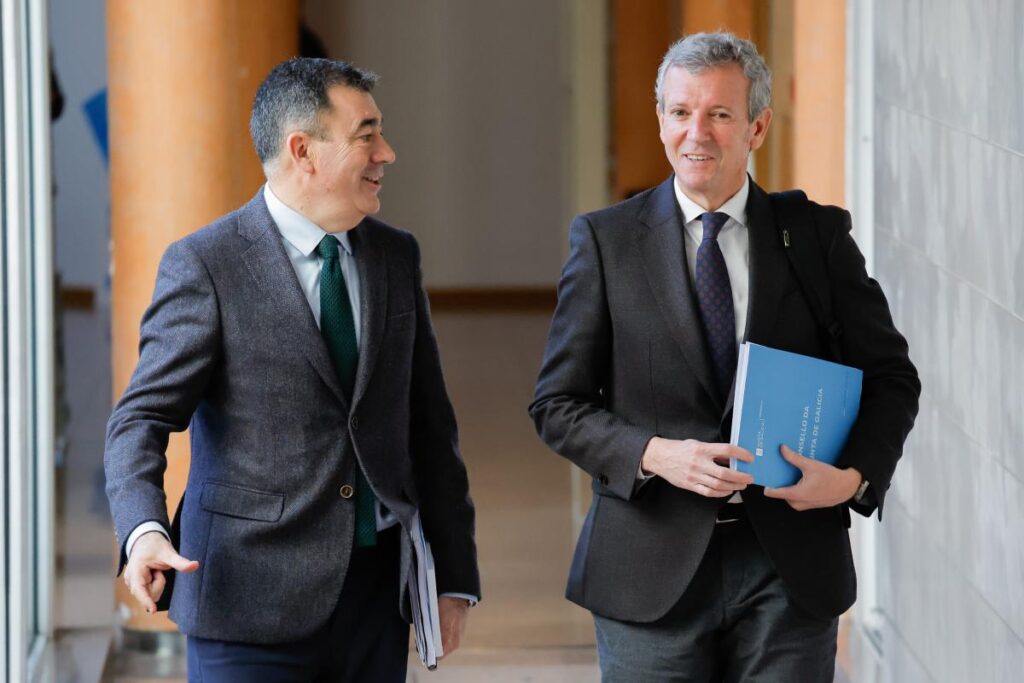
The Minister of Science, Román Rodríguez, points out that a “talent attraction” foundation will be created, which will be established this year and begin operating.
-
To ensure that research results reach society, the Venture Building model will be applied, which identifies ideas with high market potential and facilitates support until they become businesses.
-
In order for innovation to spread throughout the region, local R&D&I plans will be promoted for the first time, aiming to improve local services.
-
Innovative Public Procurement, where Galicia is a pioneer, It will be expanded to new areas to accelerate solutions that impact people and public services.
Santiago de Compostela, February 3, 2025
The President of the Xunta, Alfonso Rueda, announced today the approval by the Galician Government Council of the “Galician Research and Innovation Plan 2025-2027,” which will have an investment of €1.31 billion, almost 20% more than the previous plan. The document, which includes numerous new features following an extensive participatory process with members of the Galician R&D&I sector, will prioritize high-impact initiatives for the region, such as “biotechnology, Deep Tech (artificial and quantum intelligence), and clean technologies,” he noted. Furthermore, two of the main new features will focus on “attracting and retaining top research talent and ensuring that the results of their work reach society,” positively impacting Galicia’s economic development and the quality of life of its population.
This plan reflects the Galician government’s commitment to promoting science, an area in which significant progress has been made in recent years. In fact, as Rueda pointed out, the National Institute of Statistics (INE) has ranked Galicia as the region with the highest growth in R&D investment in 2023, the last year analyzed. “It’s 28% more, almost double the national average,” he stated. Similarly, the number of workers dedicated to R&D continued to grow, reaching 13,856, representing a 12.2% increase.
This new initiative is the result of collaborative work among all the regional ministries, represented in the Interdepartmental Commission for R&D&I, whose coordination is now reflected in this document. The Galician government’s objective, as stated by its president, is “to consolidate Galicia as a leading center for research and innovation at the European and global levels,” strengthening the region’s scientific and business fabric through a combination of work streams that build upon existing successes and promote new initiatives to remain at the forefront.
To that end, the plan allows for the planning of actions and the focusing of efforts on priority sectors where Galicia is competitive, through a strategic vision. In this way, it aims to generate a transformative economic and social impact throughout the region, offering new employment opportunities and the development of technological capabilities to improve public services and, ultimately, the lives of Galicians.
Key Measures
As explained by the Minister of Education, Science, Universities, and Vocational Training, Román Rodríguez, the plan establishes talent as an essential pillar of R&D&I. To this end, it includes measures aimed at attracting, retaining, and bringing back researchers. “One of the main measures will be the creation of a talent attraction foundation, which will be established this year and begin operating,” he explained. This foundation will allow the recruitment of professionals working anywhere in the world, with the highest quality standards and whose profiles match the needs of the Galician R&D&I ecosystem in strategic areas.
Similarly, Rodríguez announced the continuation of the Oportunius program after its “successful experience in recent years.” Thanks to this initiative, researchers who have received ERC grants—the most prestigious awarded by the European Research Council—are working in the region. As a result, they receive job offers from various countries, but Oportunius encourages them to choose Galicia.
Likewise, “it is essential that the projects developed in Galician knowledge centers reach society and have a positive impact on it,” he affirmed. To disseminate the results generated, the Ignicia program is successfully underway, facilitating the transfer of these advances to the market. With the new plan, a leap forward is being made to promote the creation of startups derived from research results. The aim is to transform scientific and technological advances into opportunities for economic and social development. To this end, the internationally recognized and established Venture Building model will be applied, which identifies ideas with high market potential and provides support until they become established businesses.
Thirdly, a “pilot office for the valorization of knowledge in biotechnology” will be designed and created in collaboration with ecosystem agents to optimize the processes of identification, protection and use of the results generated.
Among all the measures to be implemented within the framework of the plan, three priority areas will be addressed through various instruments, as they represent areas of high potential and opportunity for Galicia, and where the Galician government (Xunta) intends to focus its efforts. These areas are biotechnology, deep technologies (artificial and quantum intelligence), and clean technologies. This not only reaffirms Galicia’s commitment to excellence in R&D&I but also introduces initiatives to adapt to a constantly evolving global context and, thus, establish a solid foundation for growth.
Priority areas of work
In the field of biotechnology, where a biotechnology research and development hub will be established in Galicia, work will focus on genomic medicine, the creation of new materials, pharmacology, and agri-food. Regarding Deep Tech, artificial intelligence, and quantum computing, Galicia is seeking European funding, with the support of the central government, to create an AI factory where solutions that drive digital transformation can be designed, tested, and implemented. This factory will be linked to the Galician Supercomputing Center (CESGA), which is expanding its infrastructure with a new building and advanced equipment worth €56 million. Finally, the new plan prioritizes research and innovation for clean energy production, an area in which Galicia is already one of the leading regions in Spain.
One of the goals of the Galician government’s new science policy is to ensure that innovation benefits the entire Galician territory, including rural areas. To this end, the government will promote the creation of local R&D&I plans. Working with municipalities, these plans will identify needs in local municipal services that can be improved through R&D&I.
With the aim of integrating innovation into citizens’ daily lives, Public Procurement of Innovation will be promoted, an area in which Galicia is a pioneer and leader in Spain. These processes accelerate solutions that are not yet available on the market or require adaptation. In addition to the areas already being addressed (healthcare, unmanned vehicles, and water), new areas and themes will be added over the next three years.
“In short, we are facing a strategic plan that represents a qualitative and quantitative leap forward to put science at the service of Galicia and to enable us to face the challenges of the future with greater confidence,” said Román Rodríguez.
More than 200 people involved in the production
The development of the 2025-2027 Research and Innovation Plan began in July 2024, spearheaded by the Interdepartmental Commission for R&D&I, comprised of 32 representatives from all departments of the Galician Regional Government (Xunta). Simultaneously, consultations and collaborations were undertaken with renowned experts and members of the entire R&D&I value chain to ensure that the plan aligns with the needs and potential of Galicia’s scientific and innovative ecosystem. More than 200 people participated in the process to establish the roadmap needed to improve the economy, productive sectors, society, and the region.